
The Gate
On finally showing up as the thing I’ve been building.

I came to editorial work as a horticulturist.
That was the plan, anyway. Twenty-three years of professional horticulture, a plant science degree, hands that knew soil before they knew manuscript markup, surely the niche was obvious. Gardening books. Horticulture titles. Stay in your lane.
It didn’t work out that way, at least not immediately. I fell into fiction editing instead, which was also somewhere I wanted to be, so I didn’t resist it. But I carried the horticulturist’s brain with me anyway—the way I thought about ecosystems, about what was thriving and what was starved, about intervention versus patience. I just didn’t recognize I was doing it. It was simply how I read.
From the beginning, I knew I needed something to distinguish me. The editorial field is not small and not quiet, and “experienced fiction editor” is not a differentiator. I looked for the niche. I tried angles. Nothing quite fit, or nothing felt fully true, which amounts to the same problem.
What I didn’t see—for five years, I didn’t see it—was that I’d been doing the thing the whole time. The horticulture wasn’t separate from the editing. It was the lens I’d been using on every manuscript without naming it. The framework existed. I just hadn’t looked directly at it yet.
I looked this winter. Named it: Narrative Ecology. Started this Substack. Watched the two halves of my professional life finally stand in the same space and recognize each other.
And then I understood why I’d always needed a face for the brand that wasn’t quite my own.
The Narrative Gardener arrived three years ago as an avatar. An illustrated version of me in my garden, purple plaid shirt, pruners in hand. She could be on the website, front and center. She could anchor the brand, be someone distinct from just “Aime Sund, editor.” The idea of me, accurate in every meaningful way, but at a slight remove.
Which is so Gen X of me to say.
We grew up with a specific inheritance around self-promotion: don’t. Competence was supposed to speak for itself. And then the internet arrived and said, “Actually, you need a personal brand,” and an entire generation quietly had a small crisis and found workarounds. Mine was a drawing. She could take up space I wasn’t ready to claim yet. She went first.
The Narrative Gardener was always me. I knew that when I named her. She wasn’t a persona; she was a way of stepping onto the stage without fully stepping onto it. The anxiety of visibility dressed up as a brand decision. It worked well, when I remembered to use it.
Over time, my working framework became real and specific enough that I started thinking about it outside of edits, building services around it. The Narrative Gardener became more persistent; she wanted to be everywhere. I, however, stayed slightly behind her.
What shifted wasn’t sudden. It was a slow kind of shift, the kind where I looked up one day and realized the distance had closed without me quite deciding to close it. Once the framework had a name and a place to exist outside my website (here), once the two halves of my work were finally visible as one thing, hiding behind a drawing started to feel like a mismatch. Not dishonest. Just incomplete.
I needed updated and brand-centric photos. And now photographs of the actual person seemed less like exposure and more like accuracy.
I was still nervous about it. Privacy, imposter syndrome, the introvert’s particular discomfort with being looked at, all of it was present, none of it gone. But underneath the nervousness was something steadier. I’d been building toward this without knowing I was building toward it. New photos weren’t a vanity project. They were the next true thing.
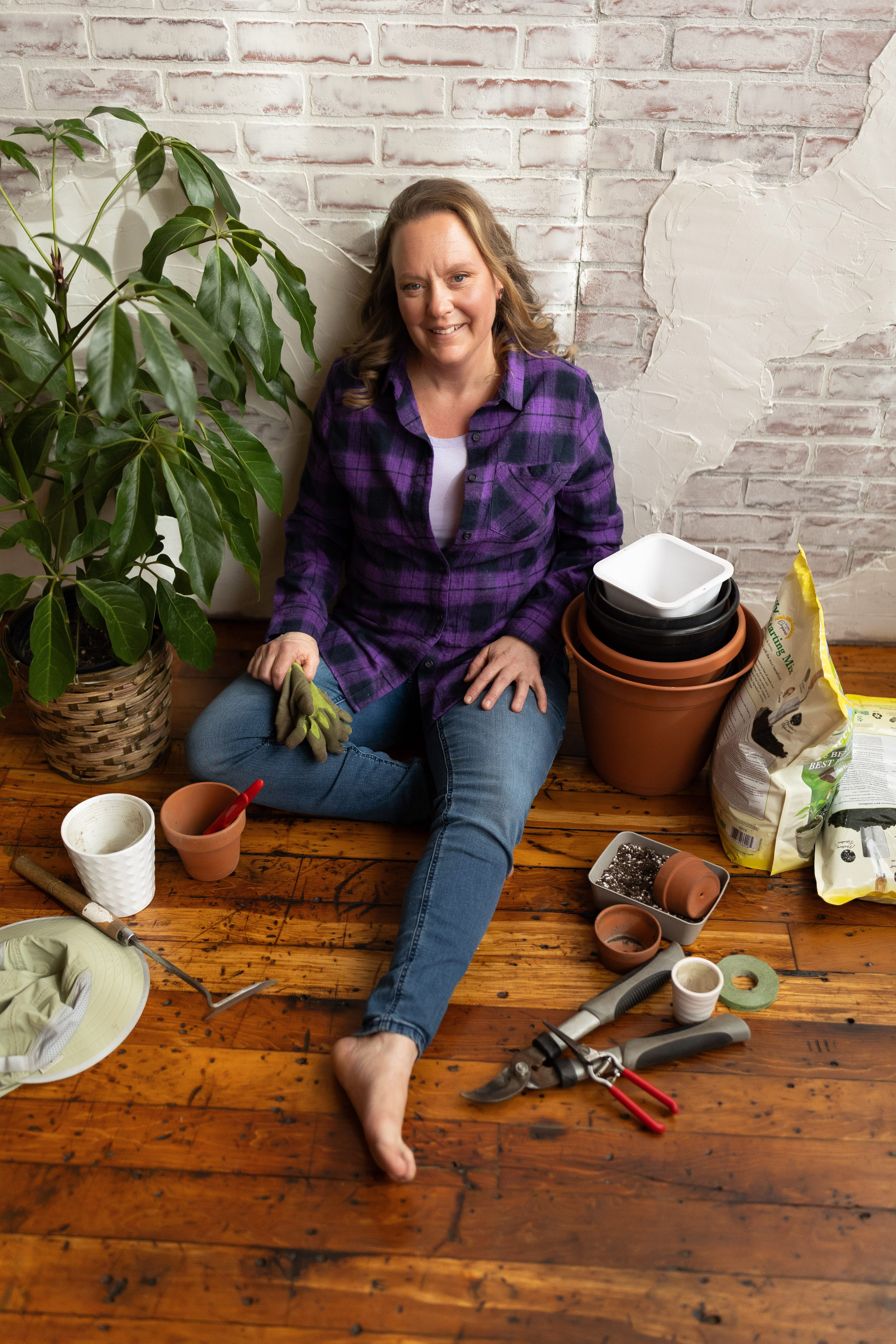
During the shoot, the photographer suggested I go barefoot for a couple shots.
I hesitated for approximately one second. The reflex formed—is that professional enough—and then dissolved. I work for myself. I spend summers with my feet in grass, mulch, and soil. More than thirty years of horticulture is not incidental to how I think about story structure; it’s the whole point. Bare feet weren’t a quirky choice. They were accurate.
I said yes.
What I noticed as the camera clicked away, was that the millisecond of hesitation was the interesting part. Not the decision; the decision was easy once I actually made it, but the reflex to check myself against some external standard of what a professional is supposed to look like. I’ve now been editing long enough to recognize that reflex in manuscripts and stories. It’s the same impulse that makes writers sand down their most distinctive sentences or ideas because they don’t sound like what a novel is supposed to sound like. The voice that’s most distinctly theirs is the one they second-guess first.
One of the barefoot photographs is me, actually me, sitting among my tools and potting soil bags and empty pots against a whitewashed brick wall in bright sun, looking directly at the camera. It matches the avatar. That coherence was intentional—I wanted the brand to feel like a single continuous thing—but I didn’t anticipate what it would feel like to see it in digital existence. To look at a photograph and think: yes, that’s the person who does this work.
She went first. Now, I’m here.
Authors will recognize this moment too. There’s a point in revision where you stop seeing your manuscript as a collection of problems and see it as a thing that exists—finished, imperfect, yours. The work was always real. Being seen in it is the part that costs something. It’s also the part that matters.
I’ve been building toward this visibility for a while. It feels right to arrive at it with bare feet.
I love this so much. The photo is amazing. Congrats on this step! And all the ones it took to get here. <3